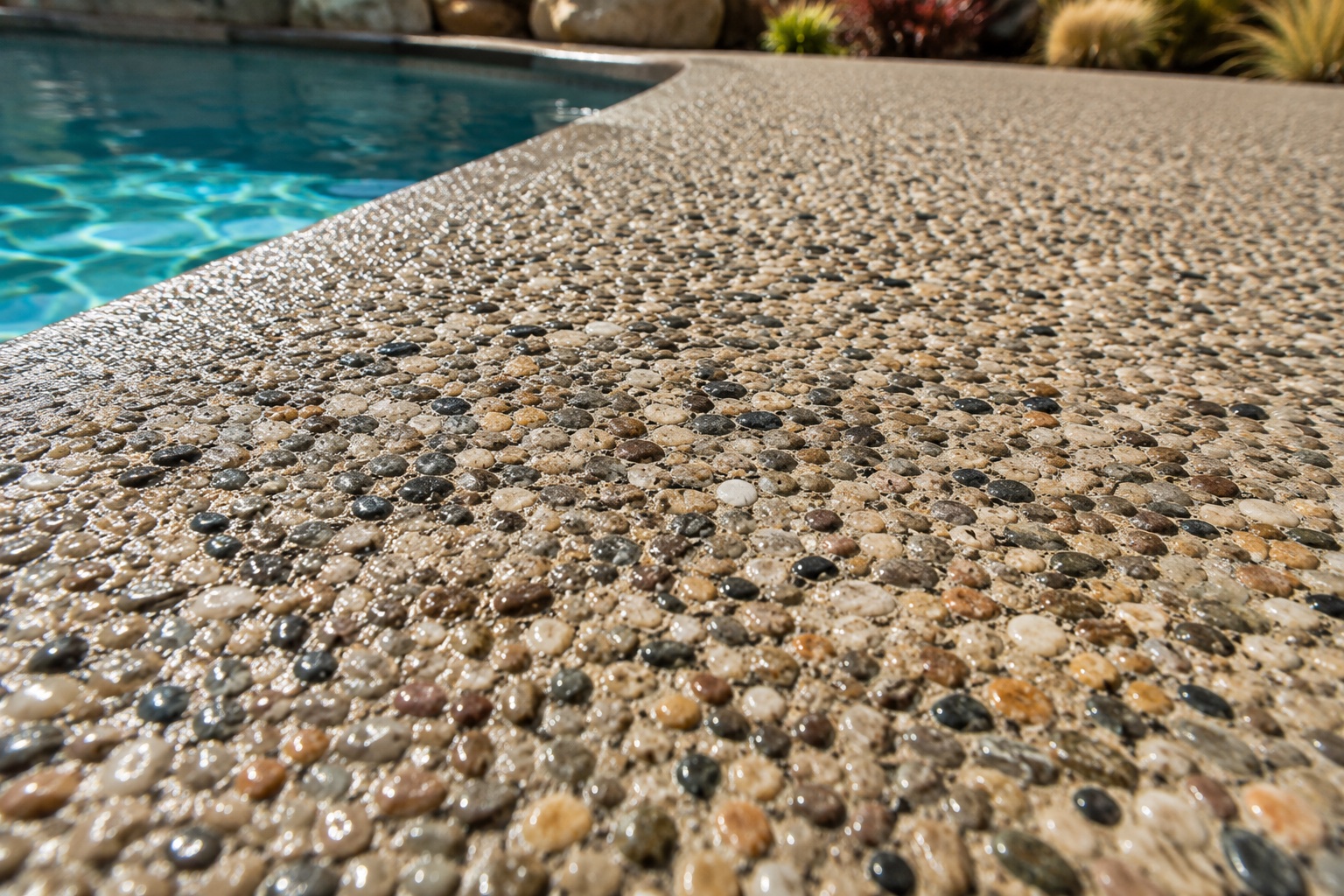
Seeding or Retarder Wash
We produce the finish two ways: seeding decorative stone into the fresh surface, or applying a surface retarder and washing off the top paste layer the next day.

 805-823-1026
Licensed & Insured
805-823-1026
Licensed & Insured
A textured, high-traction finish that reveals the stone within the mix — practical for pool decks, sloped driveways, and coastal walkways.
A textured, high-traction finish that reveals the stone within the mix — practical for pool decks, sloped driveways, and coastal walkways.
We produce the finish two ways: seeding decorative stone into the fresh surface, or applying a surface retarder and washing off the top paste layer the next day.
The exposed stone provides mechanical grip when wet from marine fog, holding up well on sloped Malibu driveways and pool surrounds.
Sealing with a solvent-based acrylic darkens the stone for a wet look while resisting spalling under repeated wet-dry cycling common near the coast.
Exposed aggregate reveals the stone within the mix — pea gravel, river rock, or crushed granite — for a textured, high-traction surface that also hides surface staining better than smooth troweled concrete, since there's no color coat to wear through.
Because salt-resistant coastal materials matter here, we select aggregates that resist spalling under repeated wet-dry cycling, and reseal on a schedule that accounts for marine-layer moisture.
Broom finish textures the top of the slab; exposed aggregate removes the top paste layer to reveal the stone underneath, giving more traction and a distinct look.
Pea gravel, river rock, and crushed granite are the most common; we can source specific colors and sizes for a particular look.
Yes — the textured surface holds traction well when wet, which is exactly the condition around a pool deck.
Every 2–3 years in Malibu's coastal environment to maintain the wet look and resist spalling.
Call 805-823-1026 or request a quote online.
805-823-1026